Chapter 4
It's Personal
Notable Innovators
Founders


Steve Jobs
BRIEF BIO
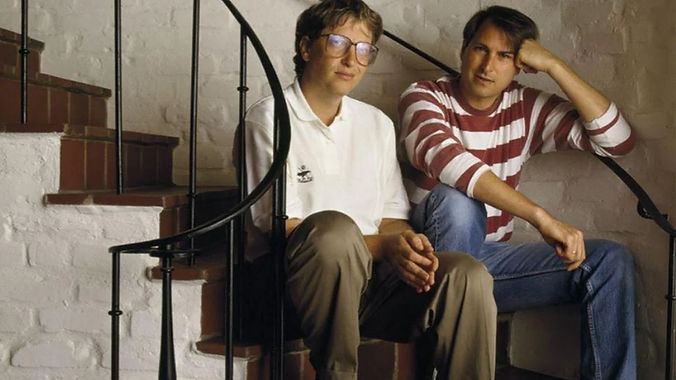
Steven Paul Jobs was born in San Francisco, California, on February 24, 1955, to Joanne Carole Schieble and a Syrian political science professor. The couple gave him up for adoption, and as an infant he was adopted by Clara and Paul Jobs. Jobs was raised by adoptive parents in Cupertino, California, located in what is now known as Silicon Valley. He dropped out of Reed College in Portland, Oregon, took a job at Atari Corporation as a video game designer in early 1974, and saved enough money for a pilgrimage to India to experience Buddhism. Back in Silicon Valley in the autumn of 1974, Jobs reconnected with Stephen Wozniak, a former high school friend. When Wozniak told Jobs of his progress in designing his own computer logic board, Jobs suggested they go into business together, which they did after Hewlett-Packard formally turned down Wozniak's design in 1976. A pioneer of the personal computer revolution of the 1970s and 1980s, Jobs co-founded Apple Inc. with Steve Wozniak in 1976. After the company's board of directors fired him in 1985, he founded NeXT the same year and purchased Pixar in 1986. Jobs returned to Apple in 1997 as CEO, where he was closely involved with the creation and promotion of many of the company's most influential products until his resignation in 2011. He died of tumor-related respiratory arrest in 2011. In 2022, he was posthumously awarded the Presidential Medal of Freedom.
ACCOMPLISHMENTS
Steve Jobs's record of innovation across multiple industries is without parallel in the modern era. In 1997, Jobs returned to Apple as CEO after the company acquired NeXT. He was largely responsible for reviving Apple, which was on the verge of bankruptcy. He worked closely with British designer Jony Ive to develop a line of products and services that had larger cultural ramifications, beginning with the iMac and leading to iTunes, Mac OS X, Apple Store, iPod, iTunes Store, iPhone, App Store, and iPad. The iPod and its accompanying iTunes store transformed the music industry by offering a seamless, legal way to purchase songs and albums and then digitally store them. The iPhone, launched in 2007, integrated a telephone, a music player, and connectivity to the internet, revolutionizing mobile phone technology and reshaping global communication. The iPad, introduced in 2010, pioneered a new era in mobile computing, enhancing content consumption, creativity, and productivity. Beyond Apple, Jobs acquired a controlling interest in Pixar, a computer graphics firm founded as a division of Lucasfilm, and under his leadership the studio produced Toy Story — the world's first fully computer-animated feature film — and went on to revolutionize the animation industry. Jobs is listed as either primary inventor or co-inventor in 346 United States patents or patent applications related to technologies ranging from computers and portable devices to user interfaces, speakers, keyboards, and packaging.
IMPACT
Steve Jobs's impact on technology, culture, and commerce was so pervasive that it continues to shape the world long after his death. Jobs reshaped the music industry with the iPod, the mobile phone industry with the iPhone, and the movie industry with Pixar Animation Studios. He also transformed the publishing industry with iBooks and media subscription services. Most tech companies specialized in either hardware or software, but Jobs pursued both. Apple built systems encompassing hardware and software, closely aligning the device and its operating environment to optimize system performance — embracing vertical integration in ways that made Apple uniquely Apple. Almost immediately after Apple released a new product, competitors scrambled to produce comparable technologies. Apple has been ranked No. 1 on Fortune's list of America's Most Admired Companies, as well as No. 1 among Fortune 500 companies for returns to shareholders. His philosophy extended far beyond products. Jobs demonstrated the value of amalgamating technology, art, and user-centric design. As he put it: "Technology alone is not enough. It is technology married with the liberal arts, married with the humanities, that yields the results that make our hearts sing." His name remains synonymous with innovation, creativity, and the relentless pursuit of excellence. His contributions to technology, design, and human-centric innovation continue to inspire engineers, scientists, and technologists worldwide. Apple's market capitalization reached $3 trillion in 2022 — a monument to the vision of a college dropout who once built computers in a garage.


Hardware


Steve Wozniak
BRIEF BIO
Stephen Gary Wozniak, born August 11, 1950, also known by his nickname Woz, is an American technology entrepreneur, electrical engineer, computer programmer, and inventor. In 1976, he co-founded Apple Computer with his early business partner Steve Jobs. Wozniak grew up in San Jose, California, which would become the epicenter of Silicon Valley, and has had a lifelong passion for mathematics and electronics. He briefly enrolled at the University of Colorado Boulder and then returned to the San Francisco Bay Area and attended the University of California, Berkeley. Wozniak built his first computer when he was 13 years old and was an electronics prodigy in high school. At 20, he met 16-year-old Steve Jobs and the two teenagers built an electronic "blue box" enabling them to hack the public telephone network and make toll-free calls. While working as an engineer at HP, Wozniak designed his own microcomputer in 1976 using a new microprocessor, but the company was not interested in developing his design. Jobs, who was also a Homebrew Computer Club member, showed so much enthusiasm for Wozniak's design that they decided to work together, forming their own company, Apple Computer. After a small airplane crash in 1981 caused temporary traumatic amnesia, Wozniak re-enrolled at UC Berkeley under the pseudonym Rocky Raccoon Clark, ultimately earning his degree in electrical engineering and computer science in 1986 — a diploma that listed that name rather than his own.
ACCOMPLISHMENTS
Steve Wozniak's engineering accomplishments represent some of the most consequential individual feats of invention in the history of computing. The Apple I was revolutionary. It consisted of a green circuit board separately connected to a keyboard and a video monitor. Wozniak had designed it to plug into any home television and be used with almost any computer keyboard. Though it lacked a power supply and casing, it introduced the foundation of the modern desktop computer. He was the primary designer of the Apple II, introduced in 1977, known as one of the first highly successful mass-produced microcomputers. The Apple II, which combined Wozniak's advanced engineering with Jobs's aesthetic sense, was the first personal computer to appeal beyond hobbyist circles. When the company went public in 1980, its market value exceeded $1 billion, which at the time was the fastest rise to that milestone in corporate history. After leaving Apple, Wozniak founded CL 9 and created the first programmable universal remote control, released in 1987. He then pursued several other business and philanthropic ventures throughout his career, focusing largely on technology in K–12 schools, which involved a 1990 initiative to place computers in schools in the former Soviet Union. He was inducted into the National Inventors Hall of Fame in 2000. In 1985, President Ronald Reagan awarded Wozniak the National Medal of Technology alongside Steve Jobs, and in 2021 he received the IEEE Masaru Ibuka Consumer Electronics Award for pioneering the design of consumer-friendly personal computers.
IMPACT
Steve Wozniak's impact on computing and society operates on two distinct but equally profound levels — the technical and the human. In an age where computing technology is central to life, Steve Wozniak's influence is undeniable. His story reminds us that a fulfilling life is not just about money, or being the best, but in making the kind of difference that we as individuals want to make. Where his partner Steve Jobs is remembered as the visionary marketer who transformed industries, Wozniak is the engineer who made it all technically possible. As the Apple co-founder, his work on the Apple I and Apple II computers transformed how people interact with machines. The Apple II was integral in launching the personal computer industry. Wozniak's design philosophy — building technology that was genuinely accessible, user-friendly, and elegantly simple — established the template that the entire PC industry followed. Beyond hardware, his post-Apple life has been defined by a deep commitment to education and civil liberties. In 1990, Wozniak helped found the Electronic Frontier Foundation, providing some of the organization's initial funding and serving on its founding Board of Directors. He is the founding sponsor of the Tech Museum, Silicon Valley Ballet, and Children's Discovery Museum of San Jose. Making significant investments of both his time and resources in education, he adopted the Los Gatos School District, providing students and teachers with hands-on teaching and donations of state-of-the-art technology equipment. His father had told him that as an engineer, you can change the world for lots and lots of people — and few have lived that creed more genuinely than Woz.


Software

Alan Kay
BRIEF BIO
Alan Curtis Kay was born on May 17, 1940, and is an American computer scientist who pioneered work on object-oriented programming and windowing graphical user interface design. Kay earned a B.S. in mathematics and molecular biology from the University of Colorado in 1966, followed by an M.S. in electrical engineering and a Ph.D. in computer science from the University of Utah in 1969, where he was influenced by early graphics research under Ivan Sutherland. Early in his career, he contributed to AI projects at the University of Utah and Stanford's Artificial Intelligence Laboratory before joining Xerox Palo Alto Research Center in 1970. There, as a principal scientist, he led the development of the Smalltalk programming language. Kay left Xerox PARC in the early 1980s. In 1983, Kay worked for Atari for a year before joining Apple Computer. While at Apple, his research team developed Squeak, an open-source Smalltalk language. In 1997, Kay moved his team to Disney's Imagineering division to continue his work on Squeak. Five years later, he established Viewpoints Research Institute, a nonprofit organization dedicated to supporting educational media for children. In addition to his technical work, Kay is an accomplished jazz musician and organist — a reflection of his belief that deep fluency across disciplines, not just computer science, produces the most profound innovation. He received the Turing Award in 2003.
ACCOMPLISHMENTS
Alan Kay's accomplishments at Xerox PARC represent perhaps the most consequential single decade of individual invention in computing history. At Xerox PARC, Kay invented Smalltalk, the first completely object-oriented programming, authoring and operating system, which included the now ubiquitous overlapping window interface. He instigated the bitmap screen, screen painting and animation, participated in desktop publishing, and the development of the Alto, the first modern networked personal computer. Additional research conducted by Kay and his team at Xerox PARC led to the development of Ethernet, client-server network architecture, desktop publishing, laser printing, and many other common computer technologies used all over the world today. His Dynabook concept, conceived in 1968 as a PhD student, envisioned a portable notebook-sized computer with a flat-panel display, keyboard, wireless networking, and GUI — a device for children of all ages to access dynamic information. His design of a graphical user interface for operating systems was used in Apple's Mac OS and later in Microsoft's Windows OS. He received the ACM Turing Award in 2003 "for pioneering many of the ideas at the root of contemporary object-oriented programming languages, leading the team that developed Smalltalk, and for fundamental contributions to personal computing." He also received the Kyoto Prize "for creation of the concept of modern personal computing and contribution to its realization" and the Charles Stark Draper Prize for "the vision, conception, and development of the first practical networked personal computers."
IMPACT
Alan Kay's impact on computing is so foundational that it operates largely invisibly — the ideas he originated are now so universal that they are simply assumed. Hundreds of millions of programmers use object-oriented languages influenced by Smalltalk. Macintosh, Windows, iOS, Android, and most Linux desktop environments derive directly from GUI frameworks pioneered by Kay's PARC team. Object-oriented programming — the paradigm Kay named and codified — became the dominant approach to software development across virtually every computing domain, from web services to mobile apps to operating systems. His credo — "the best way to predict the future is to invent it" — encapsulates a philosophy that shaped not just his own work but an entire culture of computing research. While at PARC, Kay conceived the Dynabook concept, a key progenitor of laptop and tablet computers and the e-book. He is also the architect of the modern overlapping windowing graphical user interface. The Dynabook's influence extended to the One Laptop per Child initiative. Many features of the Dynabook concept have been adopted in the design of the One Laptop per Child educational platform, with which Kay was actively involved. Kay has consistently argued that the computer revolution is still new, and that most of its good ideas have not yet been universally implemented — a perspective that reflects both his restless intellectual ambition and his enduring belief, spanning more than five decades, that computers exist above all else to amplify human learning and creativity.


Arts & Culture

Nam June Paik
BRIEF BIO
Nam June Paik was born on July 20, 1932, in Seoul, Korea, and died on January 29, 2006. He was a South Korean artist who worked with a variety of media and is considered to be the founder of video art. He is credited with the first use, in 1974, of the term "electronic super highway" to describe the future of telecommunications. Born in Seoul to a wealthy business family, Paik trained as a classical musician, spending time in Japan and West Germany, where he joined the Fluxus collective and developed a friendship American avant-garde composer John Cage, whose inventive compositions and unorthodox ideas had a major influence on the budding artist. Paik and his family fled Korea in 1950 at the outset of the Korean War, first to Hong Kong, then to Japan. Paik graduated from the University of Tokyo in 1956, and then traveled to Germany to pursue his interest in avant-garde music, composition, and performance. There he met George Maciunas and became a member of the Fluxus movement. He moved to New York City in 1964 and began working with cellist Charlotte Moorman to create performance art. Soon after, he began to incorporate televisions and video tape recorders into his work, acquiring growing fame. A stroke in 1996 left him partially paralyzed for the last decade of his life.
ACCOMPLISHMENTS
Nam June Paik's accomplishments constitute the founding canon of an entirely new art form. Paik's exhibition "Exposition of Music/Electronic Television," held in Wuppertal, West Germany, in 1963, marked the first time anyone had used video as an artistic medium. He set up multiple televisions, distorted them, made them participatory, and put them in the gallery setting for the first time. In 1969, he worked with Japanese engineer Shuya Abe to construct an early video synthesizer that allowed Paik to combine and manipulate images from different sources. The Paik-Abe video synthesizer transformed electronic moving-image making. Among his most celebrated individual works were TV Buddha (1974), in which a Buddha statue contemplated its own image on a closed-circuit television, and TV Garden (1974), a lush installation of live plants interspersed with dozens of monitors. Starting with Good Morning, Mr. Orwell (1984), he produced a number of groundbreaking live satellite-broadcast shows that emphasized the need for communication between East and West through the exchange of art and culture. He created The More the Better (1988), featuring 1,003 television sets playing videos from a variety of artists on Korean subjects, for the Olympic Games held in Seoul. In 1982, the Whitney Museum of American Art held a large-scale retrospective of Paik's work. 1n 1993, The German Pavilion, shared by Paik and Hans Haacke, won the Golden Lion award for best national representation and the Guggenheim Museum mounted a major retrospective of his work in 2000.
IMPACT
Nam June Paik's impact on art, technology, and culture is foundational, visionary, and still expanding. Paik's video art remains relevant today as forming the foundations of digital and electronic art and inspiring such artists as Ryan Trecartin, Cory Arcangel, and Christian Marclay. His prescient vision of a networked, media-saturated world proved almost unnervingly accurate. Paik's prescient claims that "everybody will have his own TV channel" are more true than ever today with the rise of social media. His coining of the phrase "electronic superhighway" in 1974 anticipated the internet by two decades, capturing in a single image the idea of a vast, high-speed global network of information and culture that would one day connect everyone on earth. A keen desire to humanize technology underlies all of Paik's work — whether seen through the combination of anthropomorphic objects with video imagery, the use of a live person in dialogue with technological components, or the forced interaction of a viewer with a particular artwork — his work incites reflection on both our relationship with technology and its effects on, and benefits for, modern humanity. Paik sought to overturn the passive, one-way flow of data typical of electronic media in the 1970s and 1980s. In transforming the television from a passive box into an active instrument of art, communication, and cultural dialogue, Paik did not merely create a new medium — he prophesied the entire digital world that followed.


